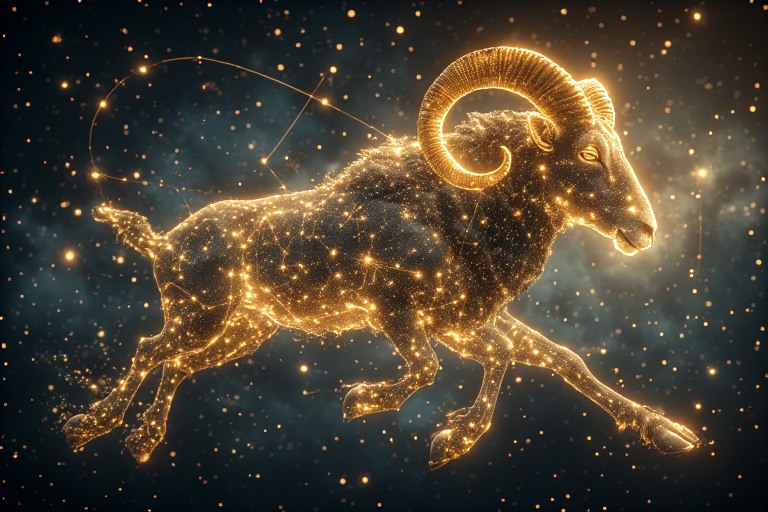
If you’ve heard “Aries Constellation” only in horoscopes, you’re missing the best part: Aries is also a real constellation—an ancient star pattern that sits right on the zodiac belt of the sky. It’s not a giant, flashy constellation like Orion, but it’s historically important because it’s tied to the idea of the zodiac “starting point” and to one of the most famous myths in Greek storytelling.
In this guide, I’ll explain Aries from both angles: what you can actually see in the night sky (astronomy) and why it became a symbol of bold beginnings (mythology and astrology). By the end, you’ll know where to look, which stars matter, and how Aries the constellation differs from Aries the zodiac sign.
Quick facts (Aries at a glance)
- Constellation Name: Aries (The Ram)
- Zodiac Constellation: Yes (lies along the Sun’s apparent path)
- Best Season (Northern Hemisphere): Late autumn to winter evenings
- Where it appears: Between Pisces and Taurus, near Triangulum and Andromeda
- Brightest Star: Hamal (Alpha Arietis)
- What it looks like: A short, bent line/arc of stars (not a dramatic “ram” shape to beginners)
- Why it’s famous: The “First Point of Aries” idea (historical), and the Golden Ram myth
What is the Aries constellation (and is it real)?
Yes—Aries is a real, officially recognized constellation with fixed boundaries on modern star maps. Think of a constellation as a “mapped region” of the sky rather than just a connect-the-dots shape; astronomers use these boundaries to describe where stars and galaxies are located.
Aries is also one of the zodiac constellations, meaning the Sun, Moon, and planets pass through this area of sky over time. That’s why Aries became part of astrology in the first place: ancient skywatchers noticed the planets “traveling” through a narrow band, and they used constellations along that band as markers.
Aries constellation vs Aries zodiac sign (the confusion point)
Here’s the clean explanation:
- Aries constellation (astronomy): A real star region in space with stars like Hamal star and Sheratan.
- Aries zodiac sign (astrology): A 30-degree seasonal segment in the tropical zodiac system, traditionally running around late March to April.
The key reason they don’t perfectly match today is precession—Earth’s axis slowly wobbles over thousands of years, shifting the background stars relative to the seasons. So even though astrology still calls the March equinox point “Aries” in the tropical system, the background constellation behind that point has drifted over time.
This is also why you may hear the phrase “First Point of Aries.” Historically, it referred to the equinox point when it was located in Aries, but today that equinox point is no longer in the Aries constellation. Aries didn’t become “fake”—it just shows how astronomy (stars) and astrology (season-based symbolism) evolved differently.
How to Find Aries Constellation in the Night Sky
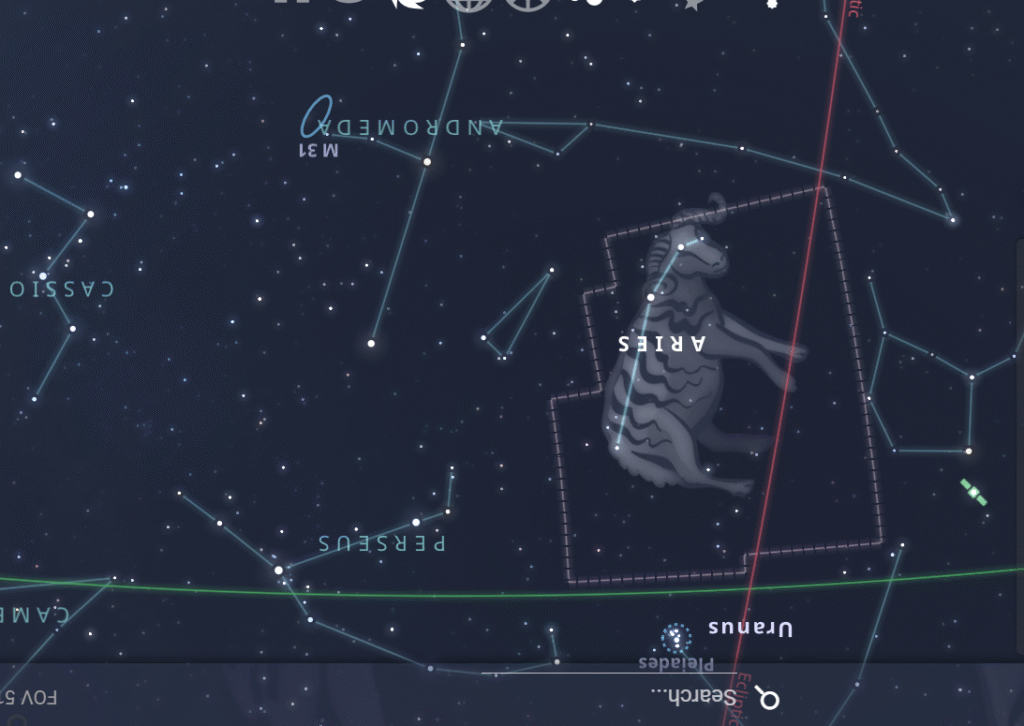
Aries is easier to find once you stop expecting a huge animal outline. It’s more like a small “hook” or bent line of stars sitting between two famous zones: Pisces (to one side) and Taurus (the other side, with the Pleiades nearby).
Best time to see Aries (simple guide)
- Northern Hemisphere: Aries is typically best placed in the evening sky during late autumn and winter.
- India viewing tip: On clear winter nights, look up after dinner time; Aries often sits fairly high, depending on the month and your local light pollution.
If you try looking for Aries in peak summer evenings, it may be low, washed out by haze, or simply not well-positioned at a convenient time.
Beginner star-hopping (no telescope needed)
Try this method:
- Find the Pleiades (Seven Sisters) in Taurus (a tiny cluster that looks like a mini-dipper). Taurus is a bright landmark.
- Once you have Taurus, look away from Taurus toward a slightly emptier region—Aries sits between Taurus and Pisces.
- Look for a short curve of 2–3 noticeable stars. The standout is Hamal (often the easiest anchor in Aries).
- If your sky is dark enough, you’ll notice Aries feels like a small “bridge” between the richer Taurus region and the dimmer Pisces region.
What does Aries look like?
To most people, Aries doesn’t scream “ram.” Ancient observers imagined a ram from a minimal pattern, but visually you’ll see:
- A compact, slightly curved line of stars
- Not a wide constellation; it feels “small and focused” compared to nearby Taurus or Perseus
- The “ram” interpretation becomes more believable when you view it on a star chart with the traditional artwork overlay
If you’re writing for your blog audience, this honesty helps: many readers fail at stargazing because blogs oversell how obvious a constellation will look.
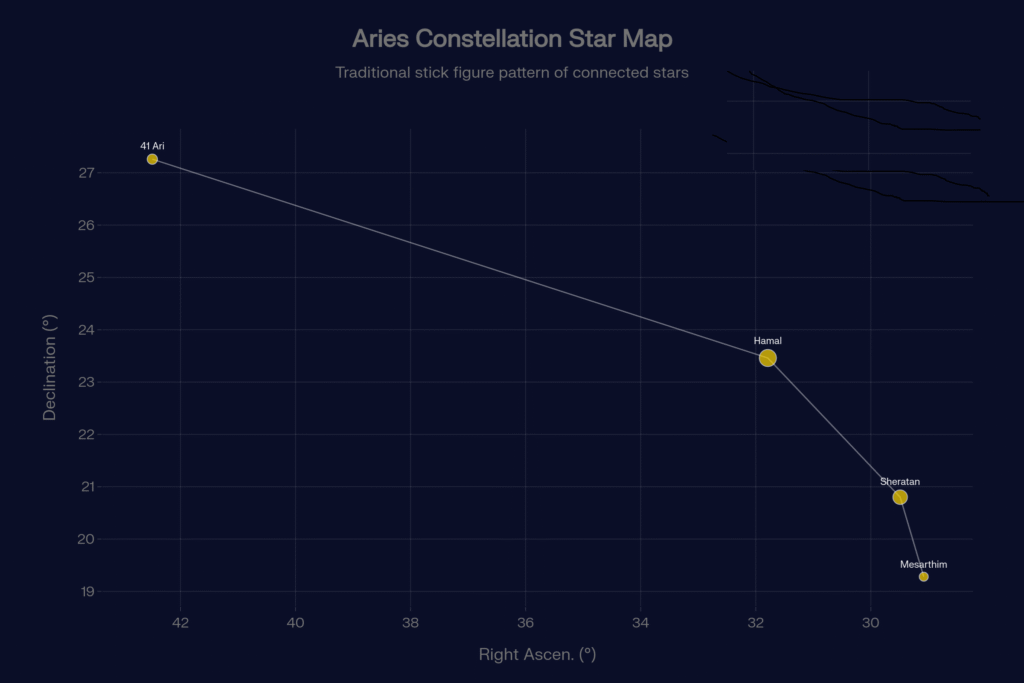
Stars in Aries (Hamal, Sheratan, Mesarthim)
Aries is not packed with super-bright stars, but it has a few named ones that matter in both astronomy and cultural history.
1) Hamal (Alpha Arietis)
The Hamal star (Alpha Arietis) is the brightest point in the entire constellation. Serving as the head of the Ram, Hamal is an orange giant located about 66 light-years away from Earth.
Symbolically, Hamal often gets linked with leadership and initiation (because Aries itself is seen as the initiator archetype). Astronomically, it’s simply the brightest visible anchor point of the Aries pattern.
2) Sheratan (Beta Arietis)
Sheratan is another key star in the Aries shape, often forming the line that makes Aries recognizable on charts. In old sky-lore, Aries’s head area is typically traced through Hamal and Sheratan.
3) Mesarthim (Gamma Arietis)
Mesarthim is famous among telescope users because it can be observed as a double star in many setups (depending on your optics and conditions). Even if your readers don’t own a telescope, mentioning “double stars” adds real astronomy value and boosts topical depth.
Does Aries have deep-sky objects?
Yes, but this is where you should set expectations. Aries isn’t the “galaxy showcase” the way Virgo is (Virgo is legendary for galaxy-hunting). Still, Aries contains distant galaxies that astrophotographers and deep-sky observers target—just not usually with naked-eye viewing.
If you want to add a strong SEO upgrade on your site, you can include:
- A small “Best telescope targets in Aries” mini-section
- A disclaimer like: “You won’t see these without binoculars/telescope and dark skies”
This keeps the article trustworthy and prevents bounce (people hate feeling misled).
Aries mythology, meaning, and modern symbolism
To truly understand the Aries constellation meaning, we have to look beyond just the stars. Historically, this constellation symbolized the return of spring and the bold, initiating energy of the Ram in Greek mythology.
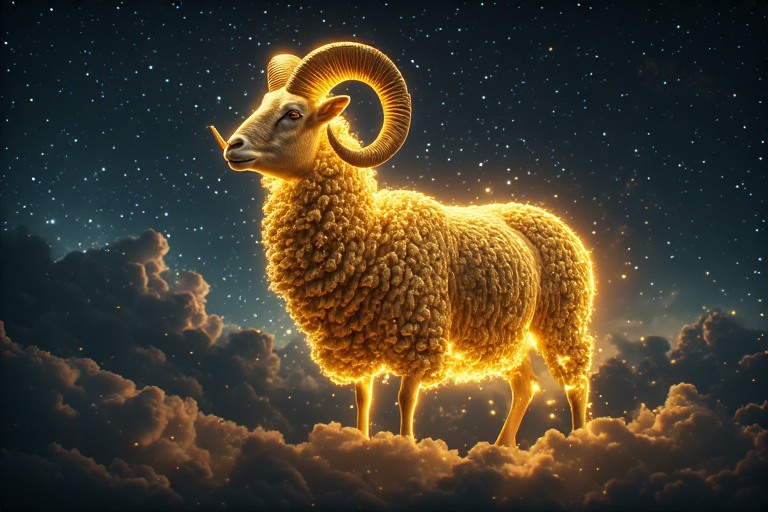
Greek mythology: The Golden Ram and the Golden Fleece
The most famous story connected to Aries is the myth of the Golden Ram. In classic Greek legend, the ram rescued the siblings Phrixus and Helle, carrying them across the sky. Helle fell (giving the name to the Hellespont in later storytelling), while Phrixus survived and later the ram became linked to the legendary Golden Fleece—a central object in the tale of Jason and the Argonauts.
This myth matters because it ties Aries to themes of:
- Rescue and divine intervention
- Daring journeys
- “Quest energy” (the start of an adventure)
Even if your blog is astrology-focused, adding the myth gives your post a timeless feel and a stronger E-E-A-T vibe (experience + cultural depth).
Aries symbolism
A ram doesn’t overthink. It charges forward, tests boundaries, and claims territory. That’s why Aries—both as constellation lore and zodiac symbolism—gets linked with:
- Beginnings and initiation
- Courage, action, and competitive energy
- Leadership, directness, independence
- Impatience when progress feels slow
A clean way to phrase this on your blog is: Aries energy is the spark, not the long burn. It starts things. It doesn’t always finish them.
FAQs
Q1: Is Aries a real constellation?
Yes. Aries is a real constellation with defined boundaries used in astronomy.
Q2: What is the brightest star in Aries?
Hamal (Alpha Arietis) is commonly listed as the brightest star in Aries.
Q3: When is Aries constellation visible?
Aries is usually easiest to spot in the evening during late autumn and winter in the Northern Hemisphere.
Q4: Is Aries constellation the same as Aries zodiac sign?
Not exactly. The constellation is a real star region, while the zodiac sign is a fixed seasonal segment used in tropical astrology.
Q5: Why is Aries called the “First Point of Aries”?
Because the March equinox point was historically located in Aries; due to precession, that point has shifted relative to the background constellations over long periods.