If you’ve ever looked up at the spring night sky and wondered where the “Maiden” is hiding, you’re not alone. While Virgo is famous in horoscopes as the sign of perfection and order, the Virgo Constellation itself is a massive, sprawling giant in the cosmos that very few people actually know how to find.
I used to think Virgo was just a zodiac sign until I pointed my telescope at it and realized: this isn’t just a pattern of stars; it’s a window into the deepest parts of our universe.
In this comprehensive guide, we go beyond the horoscope. We’ll explore the astronomy behind the second-largest constellation in the sky, its deep-sky treasures (like the galaxy containing the famous black hole), and the ancient myths from Greece to India that defined it.
Virgo Constellation: Quick Facts Table
| Feature | Data |
|---|---|
| Latin Name | Virgo (The Maiden) |
| Abbreviation | Vir |
| Size | 1,294 sq. deg. (2nd Largest) |
| Brightest Star | Spica (Alpha Virginis) |
| Best Viewing (North) | Spring (March – May) |
| Best Viewing (South) | Autumn |
| Neighboring Constellations | Leo, Libra, Boötes, Coma Berenices |
| Deep Sky Objects | Virgo Cluster, M87, Sombrero Galaxy (M104) |
| Zodiac Sun Transit | Sept 16 – Oct 30 (Astronomical) |
Is Virgo a Real Constellation? (Astronomy vs. Astrology)
Short answer: Yes, absolutely. But there is a twist that confuses almost everyone.
The Virgo Constellation is a scientifically defined region of the sky recognized by the International Astronomical Union (IAU). It is a physical group of stars, galaxies, and exoplanets.
However, the Virgo Zodiac Sign you read about in magazines (August 23 – September 22) is based on the Tropical Zodiac, a system developed over 2,000 years ago. Back then, the Sun actually passed through Virgo during those dates.
The Science of the Shift (Precession)
Due to a phenomenon called the Precession of the Equinoxes, Earth’s axis wobbles like a spinning top over a 26,000-year cycle. This wobble has shifted the view of the stars from Earth.
- Astrology Dates: Aug 23 – Sept 22 (Fixed based on seasons).
- Real Sky Dates (2026): The Sun is actually in the constellation of Virgo from roughly September 16 to October 30.
So, if you were born in early October, physically, the Sun was likely in Virgo when you were born, even if your horoscope says Libra!
Where is Virgo Constellation Located? (How to Find It Easily)
Virgo is huge, but it can be faint. The easiest way to find it is to use a famous “Star Hopping” technique used by amateur astronomers worldwide.
The “Arc to Arcturus, Speed to Spica” Method
- Find the Big Dipper: Look high in the northern sky. Locate the handle of the Big Dipper.
- Follow the Arc: Imagine a curved line extending from the handle. Follow this arc until you hit a brilliant orange star. That is Arcturus (in the constellation Boötes).
- Speed to Spica: Continue that same curved line (spike) downwards until you hit a bright blue-white star. That is Spica, the heart of Virgo.
Viewing from India & Northern Hemisphere
From locations like India, the UK, or the USA, Virgo is a “Spring Constellation.”
- March: It rises in the east around sunset.
- May: It is high in the southern sky late at night, making it the perfect time for observation.
- Look for the “Y” Shape: The main stars of Virgo form a distorted “Y” or a reclining figure, with Spica at the bottom of the Y.
The Stars of Virgo Constellation: More Than Just Points of Light
Virgo contains roughly 96 stars visible to the naked eye, but a few of them are true cosmic marvels.
1. Spica (Alpha Virginis): The Ear of Grain
Spica is the 16th brightest star in the night sky, but it’s deceiving. It looks like one star, but it is actually a binary system (two stars orbiting each other).
- Distance: ~250 light-years away.
- The Science: The two stars orbit so close together (every 4 days) that gravity distorts them into egg shapes rather than perfect spheres.
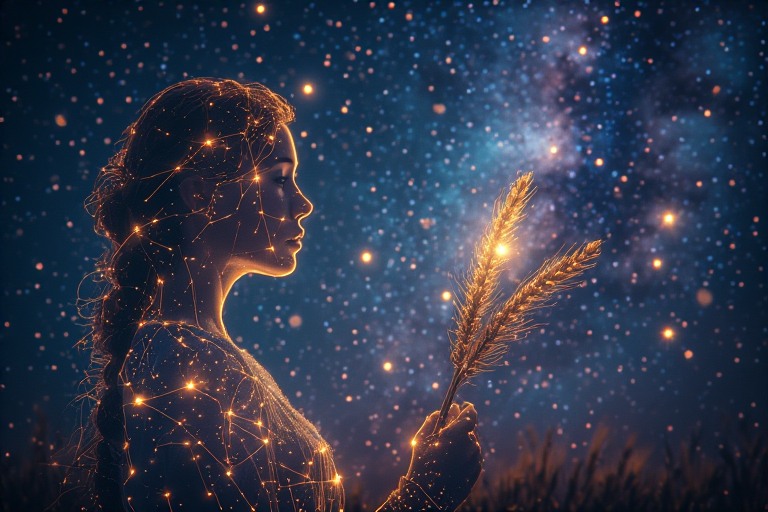
- Meaning: The name Spica comes from Latin for “Ear of Grain,” symbolizing the harvest held by the Maiden.
2. Porrima (Gamma Virginis): The Roman Prophetess
Porrima is one of the finest double stars for telescope users. Through a good telescope, you can split it into two nearly identical white stars glowing like headlights. It is named after a Roman Goddess of prophecy.
3. Vindemiatrix (Epsilon Virginis)
Known as the “Grape Gatherer.” In ancient times, the morning rising of this star signaled that it was time to begin the grape harvest.
Deep Sky Objects: The Virgo Cluster
This is the section that will make your article an “Authority” piece. Most general astrology blogs skip this, but Virgo is famous for its Galaxies, not just stars.
Virgo is home to the Virgo Cluster, a massive collection of up to 2,000 galaxies roughly 54 million light-years away.
M87: The Home of the Black Hole
You remember the first-ever picture of a Black Hole released in 2019? That supermassive black hole lives right here, inside the galaxy Messier 87 (M87) in the Virgo constellation. It is a giant elliptical galaxy emitting a massive jet of plasma.
M104: The Sombrero Galaxy
Located on the border of Virgo and Corvus, M104 looks exactly like a Mexican Sombrero hat. It is one of the most photographed objects in the universe due to its bright white core and thick dust lanes.
Note for Skywatchers: You need a telescope to see these galaxies properly, but knowing they are there adds a layer of awe when you look at this part of the sky.
Mythology of Virgo: A Global Story
While most people know the Greek story, Virgo has been a symbol of the “Divine Mother” or “Harvest Goddess” in almost every ancient culture.
Greek: Astraea and Demeter
The most common myth links Virgo to Astraea, the goddess of innocence and justice. Legend says she lived on Earth during the Golden Age. When humanity became corrupt, she fled to the sky, becoming the Virgo constellation. The scales of justice (Libra) lie right beside her.
Others associate her with Demeter, the goddess of agriculture, explaining the “wheat” (Spica) in her hand.
Indian (Vedic) Context: Kanya Rashi
In India, Virgo is known as Kanya (The Maiden). In ancient Vedic texts, she is often depicted as a girl in a boat holding fire and crops. Some interpretations link the constellation to the mother of Lord Krishna, representing purity and divine birth.
Egyptian: Isis
The Ancient Egyptians associated these stars with Isis, the goddess who brings her husband Osiris back to life. The rising of Spica was also connected to the fertility of the Nile.
Symbolism: What Virgo Represents Today
Whether you look at it through a telescope or a horoscope, the energy of Virgo remains consistent across thousands of years:
- Harvest & Abundance: Represented by the wheat star, Spica.
- Order & Analysis: The geometry of the stars and their link to seasonal calendars.
- Service & Purity: The “Maiden” archetype isn’t about physical virginity, but about being whole unto oneself—independent and self-sufficient.
Frequently Asked Questions (FAQs)
Q: Can I see the Virgo constellation in 2026?
A: Yes! The best time to view Virgo in 2026 is during the months of April and May. Look south around midnight for the bright blue star Spica.
Q: Why is Virgo called the “Virgin”?
A: The term refers to a “Maiden” or an independent woman (like a Goddess) who belonged to no man, rather than the modern definition of virginity. It represents purity of purpose.
Q: Is Virgo the largest constellation?
A: No, it is the second largest constellation in the sky, covering 1,294 square degrees. The largest is Hydra.
Q: What is the connection between Virgo and the Sphinx?
A: Some alternative historians believe the Great Sphinx of Giza was built to face the Virgo constellation (associated with Leo) around 10,500 BC, marking the Age of Leo and Virgo.
Final Thoughts: Looking Up With New Eyes
The Virgo constellation is more than just a background for your daily horoscope. It is a galactic downtown, hosting thousands of galaxies, massive black holes, and binary stars that dance in the dark.
Next time you are out on a clear spring night, find the Big Dipper, arc to Arcturus, and speed to Spica. When you catch that blue-white glimmer, remember: you aren’t just looking at a star; you’re looking at the harvest goddess who has guided farmers, sailors, and dreamers for millennia.